An hour of unplanned downtime costs the average manufacturer tens of thousands of euros. Most operations managers have never calculated the exact figure for their own factory.
Your day is already full, production planning needs your attention, and meanwhile you’ve had the same pump repaired for the third time this quarter. Predictive maintenance then sounds like a project for later, for when there’s time.
There’s almost never time. But you can start in three steps, without a major IT project and without stopping production.
Why reactive maintenance costs more than it seems
The mechanic’s invoice is the part you see. Everything around it isn’t.
When a machine breaks down, you don’t just pay for the repair. You also pay for the lost output while the line is down, for the rush delivery that keeps the customer’s order on time, for the overtime to catch up, and for the quality losses when a second machine is pushed to cover. Those costs get spread across different cost centres, so nobody sees the total. If you don’t track them, you don’t know what maintenance is really costing you.
Preventive maintenance only solves half the problem. With fixed intervals, you replace parts on a schedule, whatever the machine’s actual condition. That feels like control. But you replace parts that still have plenty of life left, while the bearing that will actually cause trouble in three weeks goes unnoticed. Preventive maintenance is better than nothing. It doesn’t remove the uncertainty.
Step 1: work out what downtime really costs you
Predictive maintenance doesn’t start with sensors or software. It starts with a calculator and a 45-minute conversation.
In that conversation, you do one thing: work out what an hour of downtime on your critical machines costs you. Not just the repair bill, but the full damage: lost output, rush deliveries, overtime and quality losses. Once you know that figure, you can judge every investment in condition monitoring on a hard number, not a gut feeling.
Then you ask a second question: which three to five machines would hurt most if they failed? In most of the factories we visit, a handful of machines cause most of the production losses from breakdowns. Start with those, not with the cheapest or the easiest to connect. That’s where you’ll see the first real improvement in overall equipment effectiveness (OEE).
Step 2: see what your machines are doing with condition monitoring
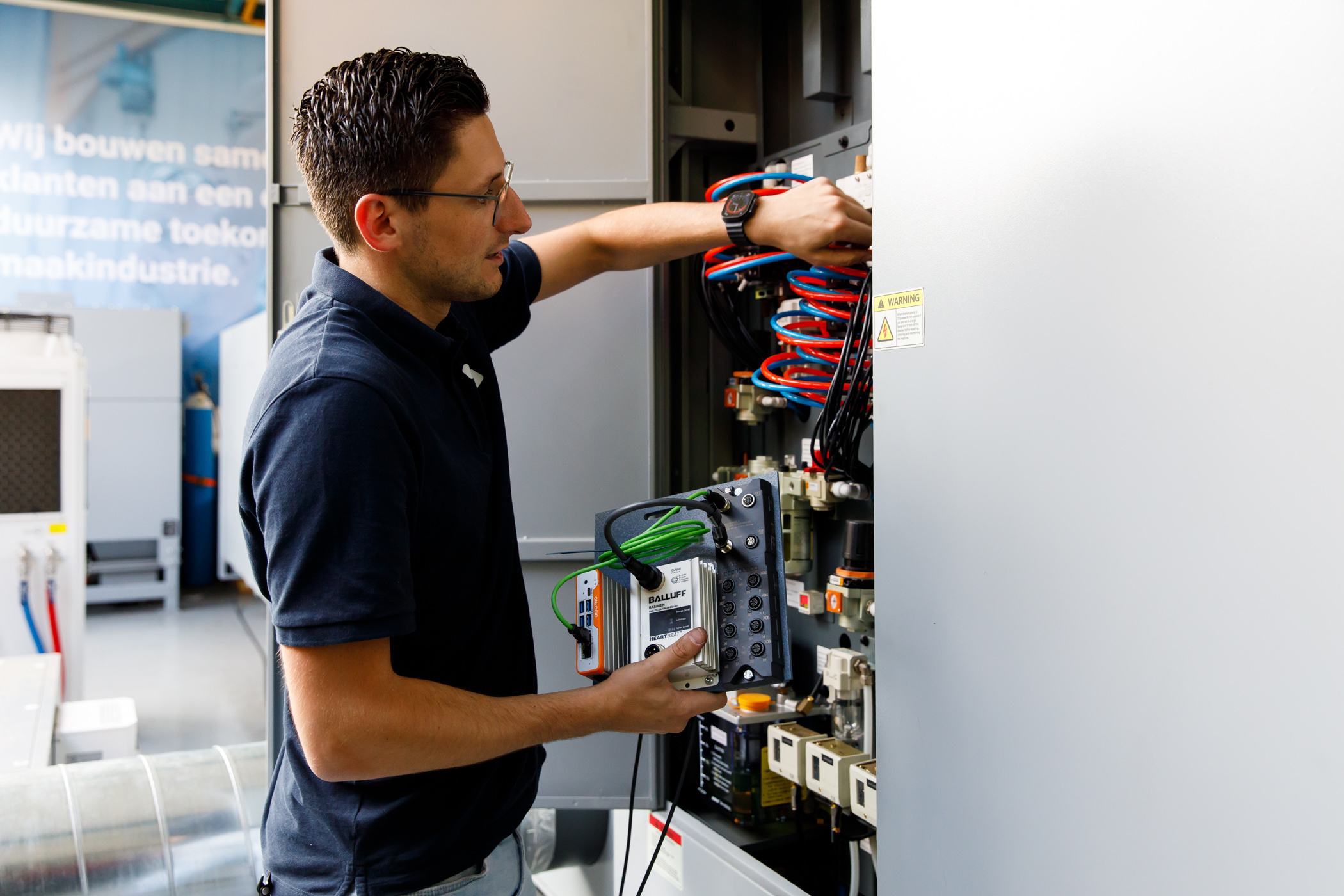
The common myth about sensors is that you have to stop production to install them. Modern sensors for machine health monitoring are compact, affordable and easy to mount on a running production line, even on machines that are twenty years old. Installing a first set doesn’t cost a single day of production time.
But sensors alone aren’t enough. Data without a baseline is noise. The difference between useful condition monitoring and a dashboard nobody opens comes down to the baseline measurement: how does the machine behave when it is healthy? Which vibration profile belongs to normal operation? Which temperature is normal, and which is an early warning? Only when you define those limits does the data start to mean something. Preventing downtime starts with knowing what normal looks like.
We saw this at a manufacturer that had been collecting sensor data for years but never acted on it. Not because the data was bad, but because no reference had ever been set. When we ran the baseline measurement and set the thresholds, we saw the first deviation alert within three weeks. The machine hadn’t reported a fault. The operators hadn’t noticed anything. But the data told a different story.
Step 3: predictive maintenance that builds its own business case
A condition monitoring system earns its keep the moment it raises an alert before something breaks.
In practice, well-configured machine health monitoring typically flags a deviation one to three weeks before a failure. That alert is more than an alarm. It includes a recommendation: which part, how urgent, and which maintenance slot fits the schedule without stopping production. That’s what a maintenance planner needs to move from firefighting to planned work. Every stoppage you prevent cuts your costs.
After a few months, you have two figures: how many failures you prevented and what they would have cost, and how your total maintenance cost has changed compared with the baseline. That before-and-after comparison is the case for expanding to more machines. An operations manager who takes it to the board isn’t asking for trust. They’re presenting numbers.
The first step takes 45 minutes
We often hear that operations managers know something has to change in how they handle maintenance, but don’t know where to start. Most projects start with the technology. That’s the wrong order. Start with the costs you can’t see.
Want to know exactly what an hour of downtime costs you? Summix works it out with you in a 45-minute conversation. That’s the first step of our five-step approach, and it’s free. Book an intro call.