Unplanned downtime on a production line costs money, time and your customer’s trust, yet almost nobody acts before a machine actually seizes up. Most operations managers sense every month that money is leaking away somewhere, but can’t say exactly where. That gap between gut feeling and hard numbers is where predictive maintenance with AI makes a difference, and it’s bigger than most manufacturers realise.
The invisible leak: what unplanned downtime is already costing you
Ask a director how much downtime cost their factory last year, and the answer is almost always an estimate, not a number. That’s not because the company is badly run. It’s because the data is scattered: some in the ERP, some in the maintenance logs, and some in your most experienced mechanic’s head. Nobody has ever brought it together.
Sound familiar? It’s Friday afternoon, in the middle of a busy delivery week, and a drive belt gives out just before the weekend. The loss shows up in OEE (overall equipment effectiveness), the productivity KPI every operations manager knows. Yet the cause often goes unaddressed until the next breakdown.
Several industry analyses, including MarketsandMarkets’ research on condition monitoring, show that many manufacturers still don’t use predictive maintenance, meaning maintenance based on the actual condition of the machine. That’s surprising, because Dutch industrial production grew at its fastest pace in four years in 2026. Machines are running harder, shifts are running longer, and there’s less room for unplanned failures as the order book fills up. For a factory that’s only just back at full capacity, a breakdown isn’t an incident. It’s a direct hit on an order book that is finally full again.
How predictive maintenance with AI works
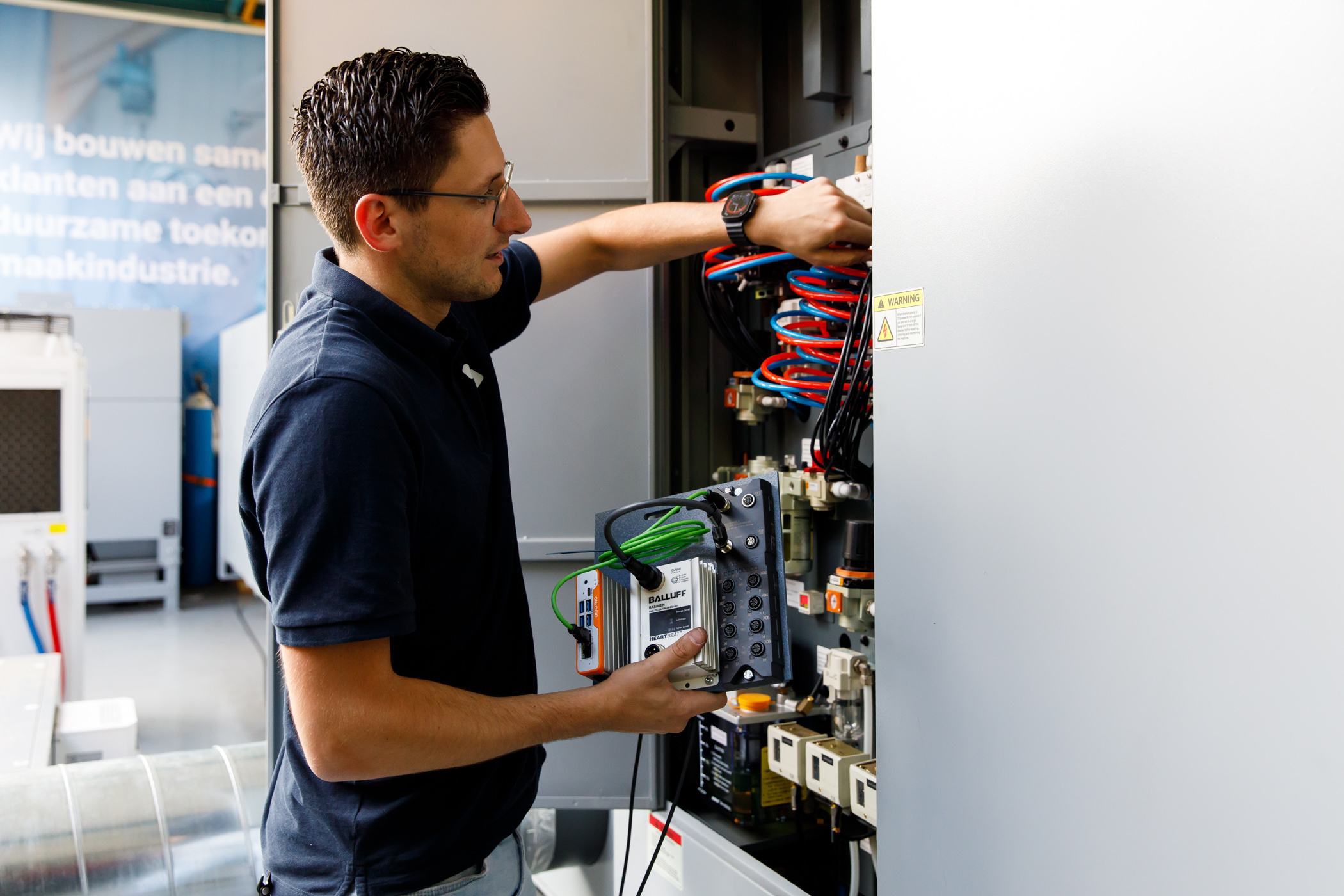
Predictive maintenance with AI comes down to measuring and learning, continuously. Sensors on key components, such as a bearing or a drive belt, stream data on vibration, temperature and power consumption. That process is called condition monitoring, and it is the foundation of every predictive maintenance system. An AI model learns what normal looks like for that specific machine and spots the early signs of failure, often weeks to months before anything breaks.
Preventive maintenance runs on a fixed schedule: parts are replaced after a set number of operating hours, whatever their actual wear. Predictive maintenance uses the machine itself as the source of information. You act on its actual condition, not on a fixed date.
This has become accessible to smaller manufacturers not because of AI, which has been around for a while, but because industrial sensors have become far cheaper. You don’t need to put sensors on every machine to get started. Most companies begin with the one machine that would hurt most if it failed, and only expand once it has proved its worth.
What predictive maintenance with AI delivers, and what it doesn’t
The ROI stories you come across online rarely apply to a factory like yours. Renault reports tens of millions of euros in savings on energy and maintenance, and GE Aerospace uses it across fleets of jet engines. Impressive results, but they say little about what a manufacturer with 50 to 250 employees can expect. Different scale, different budget, different maintenance team.
What you can borrow is the method: work out your own payback period. Take the machine that costs the most production hours when it fails, multiply that by what those hours are worth and by how often it fails, and in one afternoon you have a more realistic case than any average from a market report.
That’s why a baseline measurement says more than a promise. A supplier who can only back up their story with industry averages is asking you to take it on trust. A baseline measurement on your own machines, before you sign a contract, shows whether the calculation adds up for your factory. That doesn’t mean every euro comes back automatically. Measure the wrong machine and you’ll get little back, however advanced the model.
How to introduce predictive maintenance, step by step
The first step isn’t an IT project. It’s a conversation. Which machines would hurt most if they failed, and what has downtime actually cost you over the past year? Once that’s clear, the next step is sensors on a few key components, without production noticing a thing, and a dashboard that shows machine health in plain language: normal, attention or critical. Green means keep working, orange means plan, red means act before it’s too late.
What you’re buying isn’t mainly technology. It’s time to respond before a warning sign becomes a breakdown. And it’s an answer to a question most directors still leave unanswered: what does it cost to put this off for another year?
Want to know what that means for your factory? Book a 45-minute conversation where we work out which machines matter most and what downtime really costs you.